As fiber optic networks continue to expand, efficient signal distribution becomes essential. The PLC optical splitter (Planar Lightwave Circuit splitter) is one of the most widely used passive components in modern optical communication systems.
A fiber optic PLC splitter distributes a single optical signal into multiple outputs with high uniformity and low loss, making it ideal for large-scale fiber deployments such as FTTH (Fiber to the Home).
Compared to traditional splitting technologies, the fiber PLC splitter offers superior performance, scalability, and reliability—making it a core component in today’s high-speed broadband infrastructure.
A PLC optical splitter is a passive optical device fabricated using silica waveguide technology on a planar substrate. It divides optical signals evenly across multiple output ports.
Uniform optical power distribution
Low insertion loss
Wide operating wavelength range
Compact size and high stability
Scalable channel configurations
Unlike FBT (Fused Biconical Taper) splitters, PLC splitters are manufactured using semiconductor processes, ensuring consistent performance across all outputs.
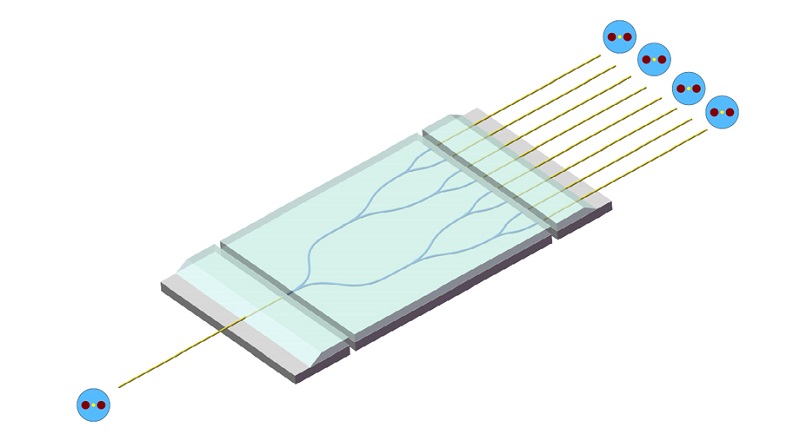
A plc splitter is primarily used to distribute optical signals from a single source to multiple endpoints in fiber optic networks.
Fiber to the Home (FTTH) networks
Passive Optical Networks (PON)
Optical signal monitoring systems
Cable TV (CATV) distribution
Data center optical routing
In FTTH deployments, a single optical signal from the central office is split into multiple signals to serve multiple users efficiently.
The core function of a fiber plc splitter is to split optical power evenly while minimizing signal degradation.
Signal Distribution
Divides one optical input into multiple outputs.
Power Balancing
Ensures uniform signal strength across all output channels.
Network Efficiency
Reduces the need for active components, lowering cost and complexity.
Scalability
Supports expansion of fiber networks without major infrastructure changes.
The working principle is based on planar waveguide technology.
Optical signals enter the input fiber.
Light is coupled into a planar waveguide chip.
The waveguide circuit splits the signal into multiple paths.
Each output port receives a portion of the optical power.
The splitting process is highly controlled, ensuring minimal variation between outputs.
When evaluating a plc optical splitter, several technical parameters are critical:
| Parameter | Description | Typical Value |
|---|---|---|
| Insertion Loss (IL) | Signal loss during splitting | Low (< 0.3–0.5 dB) |
| Uniformity | Power consistency across outputs | Very low variation |
| Return Loss | Reflection back to source | High (> 50 dB) |
| PDL (Polarization Dependent Loss) | Loss variation due to polarization | < 0.2 dB |
| Operating Wavelength | Supported optical range | 1260–1650 nm |
| Operating Temperature | Environmental tolerance | -40°C to +85°C |
These parameters directly impact network performance and reliability.
PLC splitters are used in a wide range of industries and applications.
Distributes signals to multiple households
Enables cost-effective broadband deployment
GPON / EPON systems
Centralized signal distribution
Optical signal routing
Network redundancy and monitoring
Broadcast signal distribution
Multi-user video delivery
Signal tapping
Performance analysis
Understanding the differences helps in selecting the right solution.
| Feature | PLC Optical Splitter | FBT Splitter |
|---|---|---|
| Technology | Planar waveguide | Fiber fusion |
| Uniformity | Excellent | Moderate |
| Scalability | High (1×64+) | Limited |
| Wavelength Range | Wide | Narrower |
| Cost | Slightly higher | Lower for small ratios |
| Reliability | High | Moderate |
A PLC optical splitter is used by connecting the input fiber to the optical signal source and distributing the output fibers to different endpoints. Proper installation ensures minimal signal loss and optimal network performance.
PLC optical splitters offer uniform signal distribution, low insertion loss, and high reliability. They also support a wide wavelength range and large-scale network expansion.
A PLC optical splitter divides a single optical signal into multiple outputs while maintaining consistent signal quality. It enables efficient and scalable fiber optic network distribution.
The PLC splitter solutions from Meisu Optics are designed for high-performance optical networks, offering:
Excellent uniformity and low insertion loss
Wide wavelength compatibility
High reliability in harsh environments
Flexible configurations for various applications
With advanced manufacturing and strict quality control, Meisu Optics delivers scalable and cost-effective fiber plc splitter solutions tailored to modern network demands.
The PLC optical splitter is a fundamental component in modern fiber optic systems, enabling efficient, scalable, and reliable signal distribution. With its superior uniformity, low loss, and wide application range, it remains the preferred solution for FTTH, PON, and data center networks.
By understanding its working principle, functions, and selection criteria, users can deploy the right fiber optic PLC splitter to maximize network performance and future scalability.
 English
 日本語
日本語 한국어
한국어 français
 Deutsch
 Español
 italiano
 русский
 português
 العربية