In modern photonics and optical communication systems, maintaining signal integrity is critical—especially when polarization-sensitive applications are involved. This is where the PM fiber splitter (polarization-maintaining fiber splitter) becomes indispensable.
A PM splitter is a passive optical device that distributes optical power into multiple outputs while preserving the polarization state of the input light, ensuring stable and predictable signal behavior across complex systems.
Unlike standard fiber splitters, which can introduce polarization drift and degrade system performance, PM fiber splitters are specifically engineered for precision, stability, and high-performance optical systems.
A PM fiber splitter is built using polarization-maintaining fiber (PMF), which ensures that light propagates along defined axes—typically referred to as the fast axis and slow axis.
Maintains polarization state during signal splitting
Supports precise optical power distribution
Designed for polarization-sensitive systems
Available in configurations such as 1×2, 1×4, 1×8, up to 1×64
In applications like coherent communication or fiber sensing, even small polarization changes can cause signal fading, noise, or measurement errors. PM splitters eliminate this risk by ensuring consistent polarization alignment throughout the optical path.
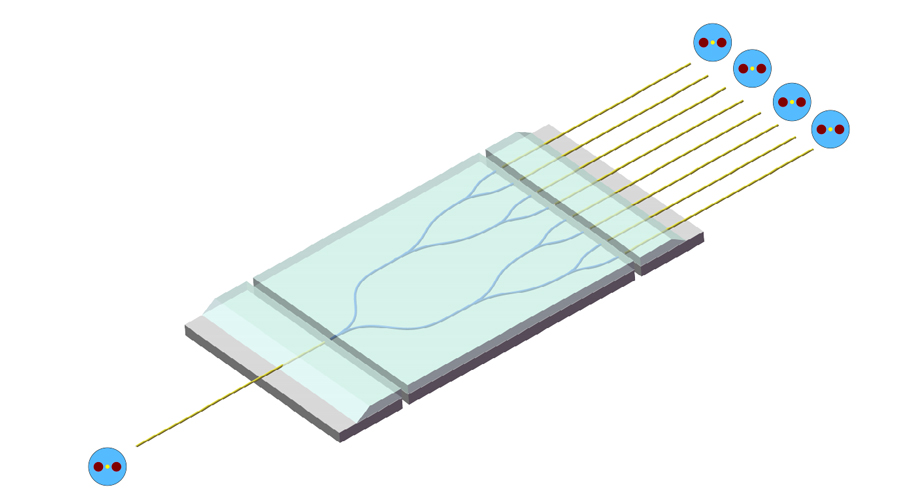
The operation of a PM fiber splitter is based on two key physical concepts:
PM fibers are designed with asymmetric structures (such as Panda or Bow-Tie designs) that create birefringence, meaning light travels at different speeds along two orthogonal axes.
Fast axis: lower refractive index → faster propagation
Slow axis: higher refractive index → slower propagation
When light is aligned with one of these axes, its polarization state remains stable over long distances.
A critical requirement is precise alignment of polarization axes across all ports. Any misalignment leads to:
Polarization crosstalk
Reduced extinction ratio
Performance degradation
PM fiber splitters are widely used in industries where polarization stability is essential.
Fiber optic gyroscopes (FOG)
Distributed sensing (temperature, strain)
Current and voltage sensors
They ensure accurate measurements by maintaining polarization integrity.
Optical coherent receivers
Local oscillator signal distribution
High-speed transmission systems
PM splitters prevent polarization-induced signal distortion.
Quantum key distribution (QKD)
Photon polarization state preparation
Stable polarization directly impacts quantum bit error rate (QBER).
Interferometers
Laser systems
Precision metrology
Navigation systems
High-reliability sensing
Harsh environment applications
Selecting the right PM splitter requires careful consideration of system requirements.
Common configurations: 1×2, 1×4, 1×8, 1×16
Choose based on system architecture
Look for high PER (≥20 dB)
Ensure low PDL
| Type | Best For |
|---|---|
| PLC | High channel count, uniform output |
| FBT | Custom ratios, flexible design |
Ensure compatibility with your system wavelength:
1310 nm
1550 nm
Custom wavelengths (e.g., 980 nm, 1064 nm)
Bare fiber
Steel tube
ABS box
Rack-mounted
Choose products with:
Wide temperature range
Low temperature-dependent loss
| Feature | PM Fiber Splitter | Standard Splitter |
|---|---|---|
| Polarization Control | Maintained | Not controlled |
| Application | Precision systems | General telecom |
| PER | High | Not applicable |
| Cost | Higher | Lower |
| Performance Stability | Excellent | Moderate |
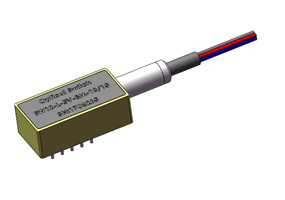
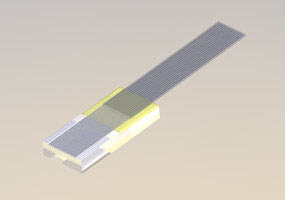
The PM PLC splitter from Meisu Optics is designed for high-performance optical systems, offering:
High extinction ratio
Excellent uniformity
Wide wavelength range
Compact size and high reliability
With advanced manufacturing and strict quality control, Meisu provides customizable and scalable PM splitter solutions for demanding applications.
A PM fiber splitter is used to split optical signals while preserving their polarization state, making it essential for applications like fiber sensing, coherent communication, and quantum optics.
PM fiber splitters are available in configurations such as 1×2, 1×4, 1×8, and can scale up to 1×64 or more. The exact number of output fibers depends on the application requirements and splitter design.
PM fiber splitters maintain stable polarization and deliver high precision with low insertion loss. They are highly reliable and suitable for advanced optical systems across various wavelengths and environments.
The PM fiber splitter is a critical component in advanced optical systems where polarization integrity cannot be compromised. From fiber optic sensing to quantum communication, its ability to maintain polarization while distributing optical power makes it indispensable.
By understanding its working principle, performance parameters, and selection criteria, engineers and system designers can choose the right PM splitter to ensure maximum system stability and performance.
 English
 日本語
日本語 한국어
한국어 français
 Deutsch
 Español
 italiano
 русский
 português
 العربية