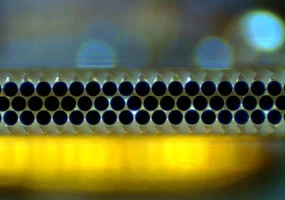
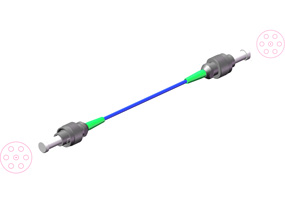
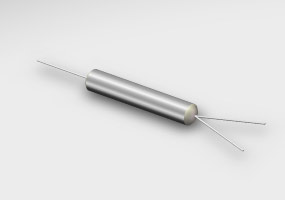
A fiber V-groove array refers to a precise arrangement in which one or multiple optical fibers (single-mode, polarization-maintaining, or multimode) are seated within microscopic V-shaped grooves etched into a substrate. The bare, uncoated portion of each fiber is nestled into these grooves, secured via pressure and adhesive, and then the end faces are polished. By machining the V-groove substrate with ultra-precision, each fiber core aligns along a defined pitch, and active alignment during assembly ensures minimal misalignment and low insertion loss. Because this structure allows stable positioning and reproducible geometry, fiber V-groove arrays serve as building blocks in linear fiber modules, allowing compact, high-density coupling and interconnect solutions for optical communication, photonic integrated circuits, and sensing systems.

Integrating a fiber V-groove array enables designers to move from discrete fiber assemblies to compact linear modules with predictable alignment. Because the V-groove substrate defines the fiber spacing (pitch) rigidly, it becomes possible to match that pitch to devices such as photonic waveguides, grating couplers, or optical switches. Meisu offers a wide range of linear fiber arrays—customizable V-groove blocks, controlled fiber-core pitch, and varying numbers of channels. The stable mechanical alignment reduces the need for manual adjustment during integration. Moreover, having multiple fibers in a fixed array supports parallel optical links, reducing complexity in multi-channel systems. These advantages make the V-groove array approach especially attractive for modules requiring compactness, repeatability, and reliable coupling performance.

Design Approach | Strengths | Trade-offs |
Fiber V-Groove Array | Precise core alignment, compact integration, multi-channel layout | Requires high-precision machining of substrate and polishing |
Ribbon or Fan-out Assemblies | Flexibility in routing, easier connectorization | Larger footprint, higher alignment complexity per fiber |
Loose Tube Bundles | More tolerant of bending and handling | Lower packing density, less precise alignment |
While ribbon or individual fiber bundling offers routing flexibility, and loose tube bundles allow rugged deployment, a fiber V-groove array excels in applications where space, alignment, and parallel optical paths are critical. Its ability to realize tightly packed, stable multi-fiber arrays makes it well suited for modules like WDM transceivers, optical cross-connects, or photonic integrated circuit couplings.

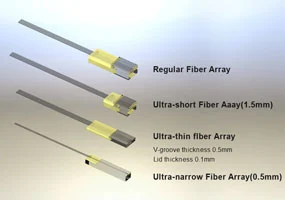
Meisu's product portfolio highlights several advanced variants of linear fiber V-groove arrays that tailor the array concept for specific coupling or optical needs. One example is the 45° FA-MT V-groove linear fiber array, in which the fiber block or tip is polished at 45° to produce a 90° reflection of the optical path—ideal for coupling to gratings or chip surfaces perpendicular to the fiber axis. Another specialization is the ultrasmall V-groove fiber array, which compresses the length, width, and thickness down to minimal dimensions (e.g. as short as 2.5 mm, narrow as 1 mm, or thin as 0.6 mm). There is also the lidless fiber array, where fibers are embedded in the grooves without a glass lid covering, enabling extremely low-profile designs where height constraints or direct end-contact with devices are needed. Meisu's flexibility in offering such variants—45°, ultrasmall, lidless, 90° bending, mixed-fiber arrangements—ensures the fiber V-groove array concept can adapt to many optical architectures.
Fiber V-groove arrays find roles across many high-performance optical systems. In high-speed transceivers, the arrays deliver multi-fiber coupling with precise alignment, enabling compact parallel links. For wavelength-selective switches, optical cross-connects, or switching fabrics, fixed fiber arrays reduce alignment complexity while ensuring consistent port geometry. In silicon photonics, coupling between chip waveguides and fibers often benefits from fiber arrays whose pitch and geometry match grating couplers or edge couplers. Meisu's 45° fiber arrays are especially targeted for aligning light into grating couplers on-chip. In sensing or imaging systems, a V-groove fiber array can act like a line of "pixels", transmitting an optical image from one end to the other. The performance of these arrays depends critically on insertion loss, pitch tolerance (often sub-micron), angular alignment, and thermal stability. Meisu emphasizes high-precision V-groove block design and active alignment to achieve low insertion loss and accurate fiber core positions.

In summary, a fiber V-groove array offers a highly stable, scalable, and integrable platform for multi-fiber optical systems. Meisu's extensive expertise in linear fiber arrays—including 45° arrays, ultrasmall and lidless variants—ensures that designers can tailor V-groove arrays to diverse coupling, density, and alignment requirements. As optical systems push toward higher density, tighter integration, and more precise coupling, fiber V-groove arrays will continue to serve as a core enabler of modern photonic architectures.
 English
 日本語
日本語 한국어
한국어 français
 Deutsch
 Español
 italiano
 русский
 português
 العربية