A fast optical switch is not automatically a better optical switch. In many systems, increasing switching speed is only one objective among several. The switch must also introduce acceptable optical loss, provide sufficient isolation, maintain stable performance over repeated cycles, and survive the operating environment. These requirements can pull the design in different directions.
For this reason, selecting an optical switch is fundamentally a balancing exercise. The right device is the one that provides sufficient speed without creating an unacceptable penalty elsewhere in the optical or mechanical system.
Switching speed is easy to compare because it is expressed as a single time value. This makes it attractive when engineers create an initial product shortlist.
However, the required speed should come from the system's actual operating sequence. If an optical path is changed only occasionally, an extremely fast switching time may provide little practical benefit. In contrast, automated test equipment or protection systems may have a much stronger reason to prioritize fast switching.
For a high speed optical switch, therefore, the relevant question is not simply “How fast is it?” but “How fast does the application actually need it to be?”
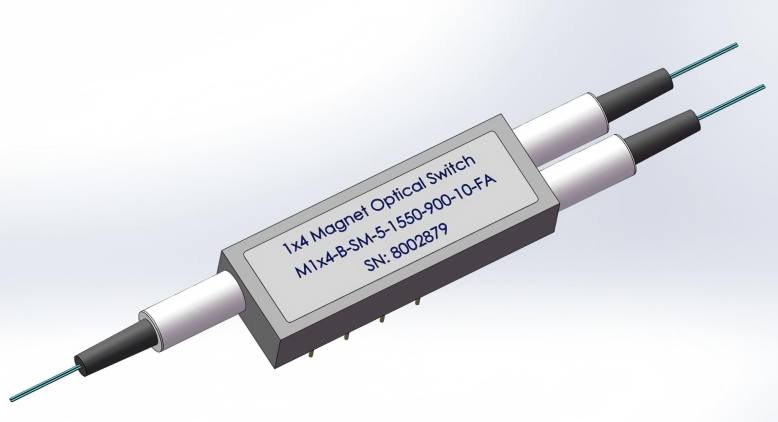
Every passive optical component consumes part of the available power budget. When insertion loss increases, less optical power reaches the next component.
This can become a significant problem in a system that already contains several passive elements. A switch may meet its switching-time requirement perfectly but still be unsuitable if its insertion loss leaves insufficient power margin for the receiver.
Engineers should therefore calculate the optical budget before setting the switch loss requirement. This makes it possible to distinguish between a specification that is genuinely necessary and one that simply looks attractive on paper.
These two parameters should be evaluated independently first and then considered together.
| Design priority | Key question | Potential consequence |
|---|---|---|
| Switching speed | How quickly must the optical path change? | May influence the choice of switching technology. |
| Insertion loss | How much optical power can the system tolerate losing? | Directly affects the optical power budget. |
| Isolation | How much leakage between optical paths is acceptable? | Important in routing and protection applications. |
| Reliability | How stable must performance remain over time and cycles? | Influences technology and qualification requirements. |
The correct balance depends on the application. A network protection system may place more emphasis on switching time, while a precision measurement system may give greater weight to insertion loss and repeatability.
The switching mechanism determines how the optical path changes and can therefore influence durability, response behavior, package design, and environmental sensitivity.
A mechanical optical switch physically changes the optical path. This architecture can be attractive for applications where established mechanical switching behavior and clear optical isolation are important.
However, reliability should not be judged from technology type alone. The complete design—including materials, alignment, actuator behavior, packaging, manufacturing consistency, and operating conditions—determines actual field performance.
MEMS technology provides another approach to optical switching. Instead of relying on conventional macroscopic mechanical movement, MEMS architectures use micro-scale structures to control the optical path.
This can be useful when compactness and scalable channel configurations are important. MEMS optical switches can therefore be considered when system designers need to balance package size with multi-channel optical routing.
As with any technology, however, MEMS should be evaluated against the complete specification. Channel count, switching behavior, insertion loss, environmental requirements, control electronics, and reliability targets all matter.
Not necessarily. It is too simplistic to assume that faster switching automatically means lower reliability.
Reliability depends on how the switching mechanism is designed and operated. A component may be engineered for frequent switching and still provide stable performance if the mechanism, materials, optical alignment, and control system are properly designed.
The important consideration is the relationship between switching frequency and required lifetime. A system that switches several times per day has very different durability requirements from one that changes optical states thousands or millions of times during its operating life.
Instead of asking only how many switching cycles a product can theoretically withstand, engineers should estimate the actual duty cycle.
For example, a monitoring system that changes channels periodically may generate relatively few switching events over its service life. Automated optical test equipment may produce substantially more cycles because the switch is part of a repeated measurement sequence.
The specification should therefore consider:
Expected switching events per day.
Expected service lifetime.
Whether switching occurs continuously or intermittently.
Whether optical power is present during switching.
Environmental temperature and humidity.
Required performance stability over the full operating period.
This provides a much more meaningful reliability target than choosing a generic “high durability” specification.
Speed, loss, and reliability are not the only performance considerations. When several optical paths exist within the same switch, isolation between channels can also become critical.
If the inactive channel allows too much unwanted optical leakage, the system may experience interference or measurement errors even when the selected channel has low insertion loss.
This is particularly important in protection systems, monitoring architectures, and test equipment where the distinction between active and inactive optical paths needs to remain clear.
A switch operating inside a controlled laboratory enclosure does not necessarily require the same qualification level as one installed in industrial, outdoor, transportation, or aerospace equipment.
Temperature cycling, humidity, vibration, mechanical shock, and long-term optical alignment can all affect reliability. Environmental requirements should therefore be defined before selecting the switching technology.
Packaging also matters. A mechanically robust optical switch may still require additional system-level protection if it is exposed to conditions beyond its intended operating environment.
A useful selection process can be divided into four stages.
Define the switching function. Determine what optical paths must be selected and how often they change.
Set the optical budget. Establish acceptable insertion loss, return loss, isolation, and other optical limits.
Determine the duty cycle. Translate expected switching frequency and service life into a realistic durability requirement.
Compare technologies. Evaluate mechanical, MEMS, magneto-optic, and other architectures against the complete set of requirements.
This prevents one specification—usually switching speed—from dominating the entire decision.
The most suitable fiber optical switch is rarely the device with the single best specification. Switching speed, insertion loss, isolation, reliability, package size, and environmental stability all contribute to the final system performance.
Fast switching matters when the application genuinely depends on rapid optical-path changes. Low insertion loss matters when the power budget is tight. Reliability becomes critical when switching occurs repeatedly or when equipment must operate for long periods without maintenance.
By defining these requirements together, engineers can select a switching architecture that is optimized for the real application rather than for one headline specification. That is the key to achieving a practical balance between speed, optical performance, and long-term reliability.
 English
 日本語
日本語 한국어
한국어 français
 Deutsch
 Español
 italiano
 русский
 português
 العربية