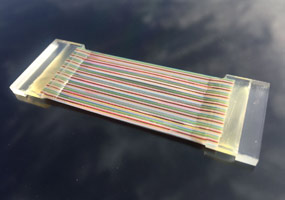
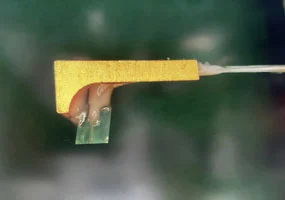
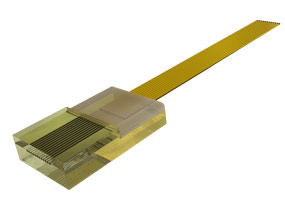
A micro optical switch is a compact mechanical-optical device designed to redirect light paths between fiber channels by actuating a tiny prism or mirror via a relay or other mechanical driver. Meisu's micro optical switch is based on this approach, offering configurations such as 1×1, 1×2, and 2×2 bypass modes. Because it is smaller in form factor than standard mechanical switches, it can be more readily integrated into tight optical modules or systems, enabling optical path selection in dense fiber settings. The micro optical switch retains many of the benefits of conventional mechanical switches—such as high isolation and flexibility—while delivering a smaller footprint and greater integrability into modern photonic designs.
At the heart of the micro optical switch lies a mechanical actuation system that physically changes the orientation of a prism or mirror to guide the incoming light to a specific output fiber. In Meisu's design, a relay mechanism turns the prism, switching the optical path with minimal disruption. This kind of architecture enables swift changeover between channels—Meisu's micro optical switch, for example, can achieve switching speeds of around 4 ms. Because the optical path is free of epoxy in the beam region and uses precise alignment, the switch maintains good insertion loss (approximately 0.7 dB) and high isolation performance, making it suitable for fiber line protection (OLP) and other routing tasks in communication systems.

The micro optical switch stands out because of its combination of compactness and performance. Its tiny case size (e.g., about 20 × 10.5 × 8 mm) allows tight integration into optical modules and subsystems where space is at a premium. Because it is mechanically based yet scale-reduced, it retains broad compatibility and robustness. It supports both latching and non-latching configurations, giving system designers flexibility in how to manage state retention after power loss. Its mechanical actuation also permits lower static power consumption when in steady state (especially for latching variants), and the epoxy-free optical path ensures clean light propagation—a key for minimizing signal degradation in sensitive fiber networks. These advantages make the micro optical switch especially appealing in high-density optical systems where module size, insertion loss, and switching reliability are all critical.
Feature | Micro Optical Switch | MEMS Optical Switch | Conventional Mechanical Switch |
Size / Form Factor | Very compact, module-friendly | Compact, but often requires MEMS chip space | Larger, bulkier packaging |
Switching Mechanism | Relay-driven prism or mirror | Micro-mirror actuated via MEMS structures | Motor or mechanical actuator moving bulk optics |
Switching Speed | ~4 ms (typical) | Faster, often sub-millisecond | Slower, tens of ms or more |
Insertion Loss | ~0.7 dB typical | Generally lower, depending on MEMS design | Varies (can be higher) |
Integration & Scalability | Very integrable into modules | High channel density possible | Better for standalone or rack-style infrastructure |
While MEMS optical switches may offer faster switching and higher channel counts, the micro optical switch shines in applications where module size, ease of integration, and compatibility with conventional mechanical designs matter. Its balance of performance and compactness makes it well suited for optical protection, bypass switching, or small-scale reconfiguration within dense fiber systems.

Micro optical switches find use in optical line protection (OLP) systems, allowing an optical link to transparently switch paths to guard against fiber failures. They are also used in small-scale optical cross connect (OXC) or switching modules, enabling dynamic rerouting within photonic networks. In measurement and monitoring setups, micro switches allow instruments to switch between fiber channels for testing without needing manual replugging. Because of their compactness, they also become attractive in integrated photonic modules and dense transceiver platforms where space is limited. Meisu's micro optical switch—thanks to its compact design, reliable switching, and integrability—offers system engineers a tool to build more flexible, responsive, and space-efficient optical networks.
In the evolving landscape of fiber optic communications, the micro optical switch stands out as a small yet powerful enabler of agile, compact, and high-performing systems. With Meisu's offerings, including fast switching, compact footprint, epoxy-free optical paths, and good isolation, it becomes possible to design optical modules that can dynamically reconfigure light paths without compromising performance. As optical networks grow denser and more dynamic, micro optical switches will remain an essential building block for flexibility, reliability, and modularity in next-generation photonic systems.
 English
 日本語
日本語 한국어
한국어 français
 Deutsch
 Español
 italiano
 русский
 português
 العربية