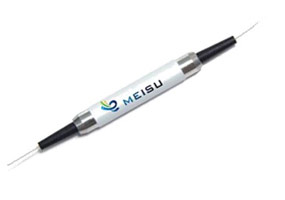
A fiber collimator is an optical device designed to convert the divergent beam emerging from a fiber end into a parallel beam (or vice versa), by placing the fiber tip at or near the focal point of a lens. This collimated or near-collimated beam can then travel longer distances without excessive divergence, enabling more reliable coupling, alignment, or further optical processing. In the context of high-precision photonics and integrated optics, fiber collimators play a foundational role—serving as interface elements in systems such as optical switches, coupling modules, and fiber arrays. The quality of a collimator—its insertion loss, beam quality, alignment tolerance, wavelength performance—influences the overall performance of the optical link.

At Meisu, the pursuit of higher precision and customization in fiber collimator design underscores the brand's technical leadership. Meisu offers high-temperature fiber collimators that can reliably operate under harsh thermal environments up to 700 °C and even 1000 °C, expanding the possibilities for optical sensing in extreme conditions. Meisu's design philosophy emphasizes careful balancing of diameter, focal length, and optical alignment to minimize aberrations and reflect stray light. By integrating these advanced collimator components into their 4D collimator array and fiber array ecosystems, Meisu supports optics designers seeking high-density, compact, and high-performance solutions for communication, sensing, and photonic integration.
What Advantages Does a Fiber Collimator Provide?
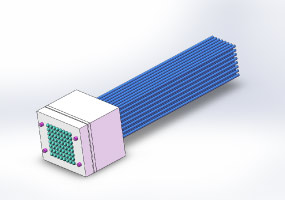
The fiber collimator is a deceptively simple but powerful component. It ensures low insertion loss by optimal alignment of the fiber and lens, high return loss by reducing back reflection, and stable beam quality over a working distance. Because the beam exiting the collimator is nearly parallel, downstream optics or detectors receive a more uniform illumination. The small size and compact pigtail form factor make collimators suitable for integrated systems, especially where space is constrained. Meisu's collimators, embedded in array formats (e.g. 2D collimator arrays), make high-density optical switching and wavelength multiplexing feasible in next-generation optical communication systems.
Feature | Single Fiber Collimator | Collimator Array (e.g. 2D array) |
Application Scale | Point-to-point links, standalone modules | High-density systems like optical switches, WSS, OXC |
Size & Footprint | Larger per-channel footprint | Compact packing of many channels |
Alignment Complexity | Aligning one fiber to one lens | Multi-channel alignment with precise pitch |
Integration | Modular and flexible | Enables dense integration in photonic hardware |
Scalability | Limited when many channels needed | Scales to M×N channels using arrays |
While a single fiber collimator is ideal for simple or small-scale links, modern systems often demand tight integration of many channels. Collimator arrays allow Meisu and its customers to scale optical functionality in compact footprints without sacrificing beam performance, making them vital for advanced optical cross-connects, wavelength switches, and photonic integrated systems.

Fiber collimators are ubiquitous in advanced optical systems. In fiber-optic communication modules—such as wavelength selective switches (WSS), optical cross connect (OXC), and optical switches—collimator arrays enable precise beam routing between fiber and free-space or MEMS-based optics. In high-temperature optical sensing systems, Meisu's temperature-resistant collimators maintain performance in harsh environments like industrial furnaces or aerospace sensors. In research and laboratory settings, collimators are used in beam alignment, coupling, calibration, and test setups, offering a stable, collimated output from fiber sources. Because many photonic subsystems operate better with collimated beams (less divergence, better coupling into lenses or detectors), fiber collimators become bridges between fiber-based optics and free-space optics. As optical integration trends advance, the demand for compact, low-aberration, low-loss collimator solutions only grows stronger.
In essence, the fiber collimator is a silent hero in the field of photonics—small in scale but monumental in impact. Meisu's commitment to high-precision, custom, and high-temperature collimator designs ensures that optical systems can push further in density, stability, and environmental tolerance. As technologies like dense wavelength division multiplexing, photonic integration, and high-end sensing continue to evolve, robust collimator solutions will remain a foundational enabler.
 English
 日本語
日本語 한국어
한국어 français
 Deutsch
 Español
 italiano
 русский
 português
 العربية