Fiber optic technology has transformed modern communication, offering unmatched speed, reliability, and signal integrity. At the heart of this revolution is the fiber optic bundle, a collection of optical fibers arranged to transmit light efficiently from one point to another.
Fiber optic bundles are widely used in telecommunications, medical imaging, industrial sensing, and lighting systems. Understanding their types, benefits, and applications is critical for engineers, network designers, and technology enthusiasts alike.
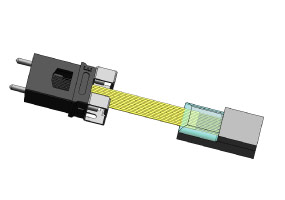
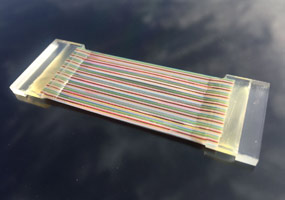
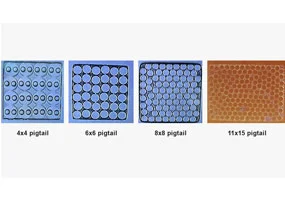
A fiber optic bundle is a group of optical fibers aligned together to transmit light signals with minimal loss and interference. Unlike single fibers, bundles enable higher data throughput and redundancy, making them ideal for complex communication systems.
Fiber optic bundles can be classified based on the type of fiber they contain:
Single mode fiber bundle: Carries one light signal per fiber for long-distance, high-speed transmission.
Multimode fiber bundle: Supports multiple light signals per fiber, suitable for short-distance applications.
Fiber optic cable bundle: A cable containing multiple fiber bundles for high-density or long-distance networking.
These bundles ensure reliable performance even in challenging environments, providing immunity to electromagnetic interference (EMI) and superior signal integrity compared to traditional copper wiring.
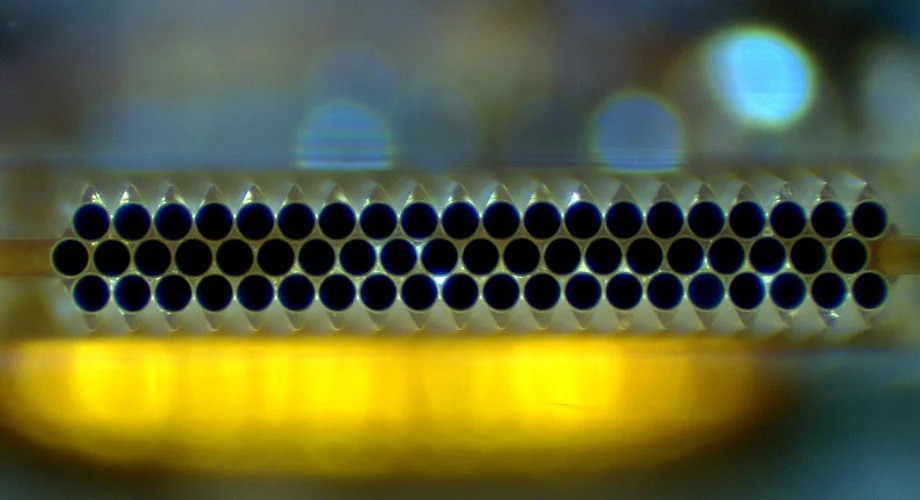
Fiber optic bundles can be categorized based on their core structure and intended applications. The following table summarizes the main types:
| Type | Core Size | Light Mode | Distance | Applications | Advantages |
|---|---|---|---|---|---|
| Single Mode Fiber Bundle | 8–10 µm | Single mode | Long-distance (up to 100 km) | Long-haul telecom, internet backbone | High bandwidth, low signal loss, long reach |
| Multimode Fiber Bundle | 50–62.5 µm | Multiple modes | Short-distance (up to 2 km) | LANs, data centers, industrial networks | Cost-effective, easy to connect, flexible layout |
| Fiber Optic Cable Bundle | Varies (multi-fiber) | Single or multimode | Varies based on fiber type | High-density networking, redundant systems | Organized installation, supports multiple fibers |
Fiber optic bundles offer numerous advantages over traditional cabling systems:
High Bandwidth and Speed
Fiber optic bundles can transmit vast amounts of data at incredibly high speeds, essential for modern communication systems.
Long-Distance Transmission
Particularly with single mode fiber bundles, signals can travel hundreds of kilometers with minimal signal loss.
Electromagnetic Immunity
Unlike copper cables, fiber optic bundles are immune to electromagnetic interference (EMI), ensuring stable, clear signal transmission.
Durability and Flexibility
Fiber bundles can bend around corners and withstand harsh environments without compromising performance.
Cost Efficiency
While installation costs may be higher, fiber bundles reduce long-term maintenance costs and improve overall network efficiency.
Security
Fiber optic bundles are difficult to tap without detection, providing enhanced data security for sensitive communications.
These benefits make fiber optic bundles the preferred choice for high-performance networks, industrial applications, and precision imaging systems.
Fiber optic bundles are versatile and widely used across industries:
Telecommunications
Fiber optic cable bundles are essential for high-speed internet, telephone systems, and long-distance data networks.
Medical Imaging
Coherent fiber bundles are used in endoscopes and imaging devices, enabling doctors to visualize internal organs with precision.
Industrial Sensors
Fiber bundles transmit data reliably in environments where traditional wiring would fail, such as high-voltage or high-temperature areas.
Defense and Aerospace
Secure, reliable communication systems rely on fiber optic bundles to prevent signal interception and maintain high-speed connectivity.
Lighting and Illumination
Fiber optic bundles are used to deliver light to remote or decorative locations, such as architectural features, displays, or flexible illumination systems.
Q1: What is a fiber bundle?
A fiber bundle is a collection of optical fibers grouped together to transmit light signals efficiently, providing high-speed and interference-resistant communication.
Q2: What are the main applications of fiber bundles?
Fiber bundles are used in telecommunications, medical imaging, industrial sensing, defense systems, and lighting applications.
Q3: What are the advantages of using fiber optics?
Advantages include: high bandwidth, long-distance signal transmission, immunity to electromagnetic interference, flexibility, durability, cost efficiency, and enhanced security.
Fiber optic bundles are indispensable in modern communication, medical, and industrial technologies. They combine speed, reliability, and versatility, making them superior to traditional cabling systems. By understanding single mode fiber bundles, multimode fiber bundles, and fiber optic cable bundles, businesses and engineers can design optimized networks, improve data transmission integrity, and future-proof their systems.
Whether for long-haul telecommunications, high-speed local networks, or precision imaging, fiber optic bundles remain a cornerstone of modern data infrastructure, providing reliable and secure communication in virtually every industry.
 English
 日本語
日本語 한국어
한국어 français
 Deutsch
 Español
 italiano
 русский
 português
 العربية