Multi-channel hermetic fiber arrays combine precise optical alignment with an airtight package interface, allowing several optical channels to pass into or out of a sealed optical module without sacrificing compactness or positioning accuracy.
For photonic devices, optical transceivers, laser modules, sensing systems, and other high-reliability assemblies, this approach can reduce packaging complexity while providing a stable optical interface between internal optical components and external fiber connections.
A hermetic fiber optic feedthrough provides an optical path through the wall of a sealed package while maintaining the required environmental isolation. Unlike a conventional fiber connection, the feedthrough must address both optical transmission and package sealing.
In a multi-channel design, several fibers can pass through one mechanical interface. This is particularly useful when an optical module requires multiple transmit, receive, monitoring, or polarization-sensitive channels.
Hermetic feedthroughs are commonly used where optical signals must cross vacuum, pressure, or environmentally isolated boundaries. Industry designs use sealing approaches such as soldering or glass sealing around metallized fibers and KOVAR structures.
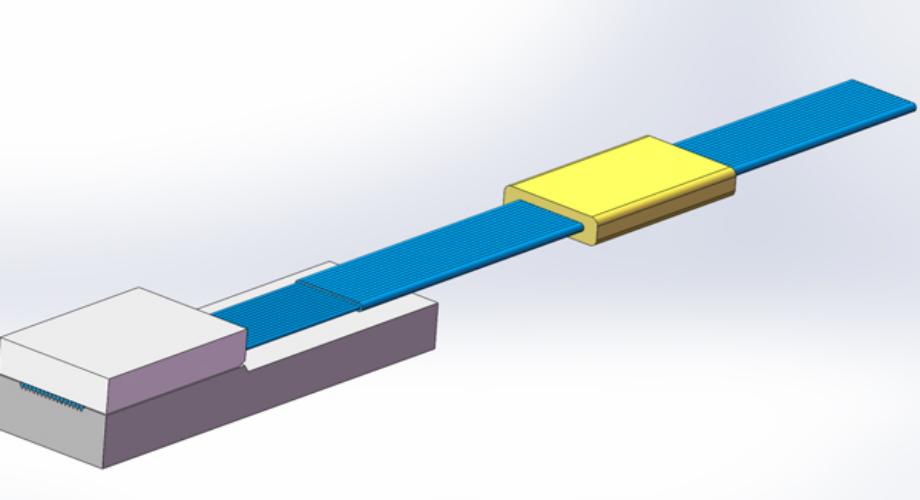
As channel counts increase, routing individual sealed fibers through separate package interfaces can consume valuable space and increase assembly complexity.
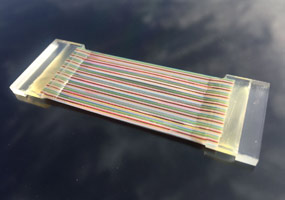
A multi-channel fiber array unit organizes several fibers at a controlled pitch so they can be handled and aligned as one optical assembly. For applications requiring coupling to laser arrays, photonic integrated circuits, detectors, or other multi-channel devices, repeatable fiber positioning becomes especially important.
MEISU's Hermetic Sealing Fiber Array supports configurations of 1, 2, 4, 8, and 16 fibers. Standard core pitches include 127 μm and 250 μm, with a specified pitch tolerance below 0.5 μm.
These parameters allow designers to select an array configuration that matches the optical channel layout while maintaining compact packaging.
The sealing structure is a critical part of the assembly.
In MEISU's design, the fiber cladding is gold-coated before the fibers are inserted into a metal KOVAR tube. The gap between the fibers and the tube is filled with solder, while the KOVAR case itself is also gold-coated to help prevent oxidation and support soldering into the optical package.
This construction provides two functions in the same component:
Accurate positioning of multiple optical fibers
A sealable metal interface for integration into a hermetic package
For manufacturing engineers, this integration can simplify the transition between precision optical alignment and package-level sealing.
KOVAR is widely used in hermetic package structures because it is suitable for joining with glass, ceramics, and other materials commonly found in electronic and optoelectronic packaging.
For a hermetic fiber optic feedthrough, the metal sleeve must also support a reliable sealing process without unnecessarily disturbing fiber positioning.
Gold plating adds another practical advantage by providing an oxidation-resistant surface that is suitable for solder-based assembly. In MEISU's hermetic design, both the fiber interface and KOVAR case are prepared to support the solder-sealing process.
Hermeticity alone does not guarantee good optical performance.
A sealed assembly can still perform poorly if fiber pitch, end-face geometry, polarization orientation, or channel position does not match the optical device. For multi-channel packaging, small accumulated positioning errors can affect coupling consistency across the array.
This is why a precision fiber array unit should be specified together with the optical interface rather than treated only as a mechanical feedthrough.
Important parameters include:
Number of optical channels
Fiber pitch
Pitch tolerance
Fiber type
Fiber end-face requirements
Polarization orientation for PM fiber
Package dimensions
Metallization and soldering requirements
Mechanical interface with the optical housing
MEISU supports PM, SM, and MM fibers in its Hermetic Sealing Fiber Array, allowing the architecture to be adapted to different optical system requirements.
A standard fiber array is primarily designed to hold and align multiple fibers accurately. A hermetic version must also provide an interface that can become part of an airtight package.
This difference affects material selection, metallization, assembly methods, and package integration.
For example, when an ordinary array is used inside a non-hermetic optical assembly, glass or adhesive structures may be sufficient for positioning. When the array crosses the wall of a sealed housing, the designer must consider how the fibers, metal sleeve, solder joint, and package body work together as a sealing system.
This makes hermetic assemblies particularly relevant for optical products where moisture, contaminants, gases, pressure differences, or long-term environmental exposure could compromise internal components.
The best configuration starts with the optical device rather than the feedthrough itself.
First, determine the required fiber type and channel count. Then match the fiber pitch to the device interface and establish the acceptable alignment tolerance. Packaging engineers should also define the available mounting space, soldering process, fiber routing direction, and hermeticity requirements.
For custom projects, it is useful to provide the supplier with:
Fiber type + fiber count + pitch + optical interface dimensions + package drawing + sealing requirements.
Providing these parameters early can reduce redesign work when integrating the hermetic fiber optic feedthrough into the final module.
Multi-channel hermetic designs are particularly useful in applications where optical density and environmental protection are both important, including:
High-reliability optical modules
Laser and detector packages
Optical communication equipment
Photonic integrated device packaging
PM fiber optical systems
Optical sensing modules
Vacuum or controlled-atmosphere optical systems
Multi-fiber feedthrough technology is also used across high-density and specialized optical packaging applications where multiple optical connections must pass through a common sealed interface.
Advanced optical packaging increasingly requires more optical channels in less space while maintaining precise alignment and reliable environmental sealing.
A multi-channel fiber array unit addresses these requirements by combining controlled fiber positioning with a package-ready hermetic structure. The effectiveness of the design depends on more than fiber count: pitch accuracy, fiber type, metallization, KOVAR construction, solder compatibility, and package geometry all need to be considered together.
MEISU's Hermetic Sealing Fiber Array offers 1-, 2-, 4-, 8-, and 16-fiber configurations, 127 μm and 250 μm pitch options, PM/SM/MM fiber compatibility, and a gold-coated KOVAR structure for high-reliability optical packaging.
For a custom hermetic optical package, defining the fiber arrangement and sealing interface early in the design process can make subsequent assembly and integration considerably more efficient.
It allows optical fibers to pass through a sealed package wall while maintaining environmental isolation.
Yes. Multi-channel designs can integrate several optical fibers into one sealed mechanical interface.
MEISU's hermetic fiber array supports PM, SM, and MM fibers.
The pitch determines how accurately multiple fibers match the corresponding optical channels of the device.
Gold coating helps protect the metal surface from oxidation and supports solder-based integration into the hermetic package.
 English
 日本語
日本語 한국어
한국어 français
 Deutsch
 Español
 italiano
 русский
 português
 العربية