High-density optical connectivity is becoming increasingly important as photonic systems require more optical channels within smaller packages. Instead of continuously increasing the number of separate optical interfaces, multi-core technology provides a practical way to increase channel density while controlling system footprint and alignment complexity.
For optical communication, silicon photonics, and other multi-channel photonic systems, the key challenge is not simply adding more channels. Each optical path must remain precisely positioned, mechanically stable, and efficiently coupled to the target device.
A multi-core optical fiber contains multiple light-guiding cores within a common cladding. Each core can provide an independent optical path, allowing more signals to be transmitted through a compact physical structure. This is one of the key concepts behind space-division multiplexing and higher-capacity optical transmission.
An MCF fiber assembly becomes particularly valuable when these multiple optical channels must connect to photonic integrated circuits, optical chips, or other precision optical interfaces.
By incorporating multi-core fibers into a precisely positioned fiber array, designers can achieve several advantages:
Higher optical channel density within a limited area
Reduced packaging footprint
More organized multi-channel coupling
Improved repeatability during assembly
Easier integration with photonic devices
This makes the technology attractive for optical systems where both bandwidth density and package size are critical.
Higher density also increases alignment requirements.
When multiple cores must couple simultaneously to corresponding waveguides or optical interfaces, small positional errors can increase coupling loss or create channel-to-channel performance variation. Fiber-to-chip coupling is therefore strongly dependent on precise and repeatable positioning.
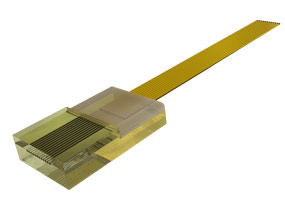
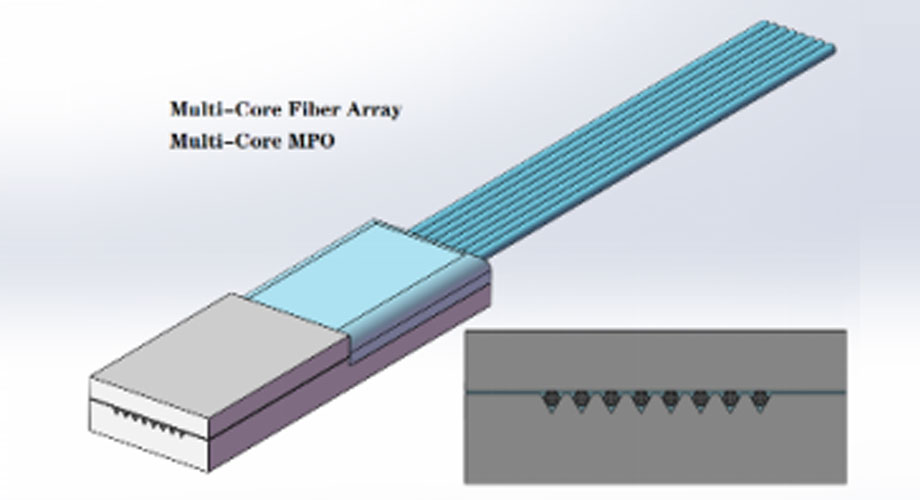
A V-groove structure provides a practical mechanical solution. The fiber is positioned inside the precision groove and secured with a cover plate, helping maintain a controlled optical position.
For MEISU's MCF Fiber Array, available configurations include 2, 4, 8, and 12 fibers, with standard core pitches of 127 μm and 250 μm, as well as customer-specified pitches. The listed pitch tolerance is less than 0.5 μm.
These parameters are especially relevant when an mcf fiber needs to match the geometry of an integrated optical chip.
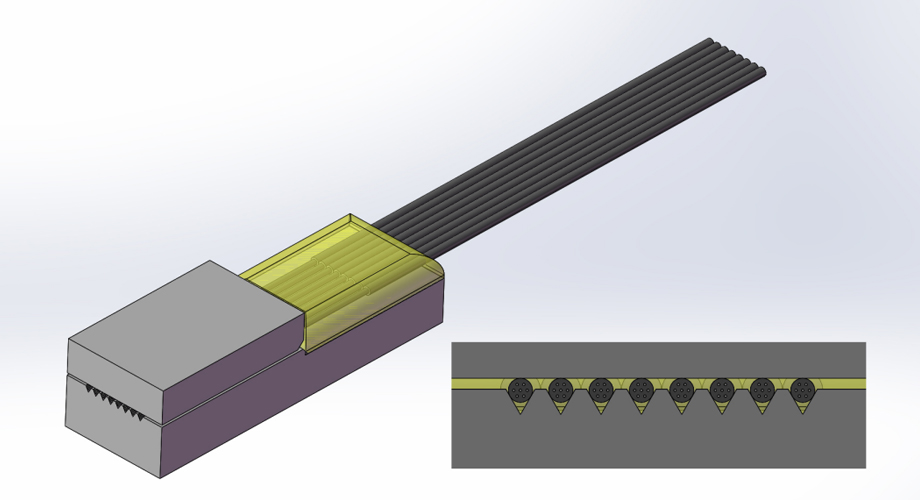
For high-density optical packaging, channel count alone should not determine component selection. Several mechanical and optical parameters should be evaluated together.
The pitch must correspond closely to the optical interface or waveguide layout. Customized pitch can be important when working with non-standard PIC designs.
Tighter positional tolerances help maintain consistent core-to-device alignment across multiple channels. MEISU also identifies fiber core pitch accuracy as a critical characteristic in precision array manufacturing.
The required number of channels should match both present system architecture and expected packaging density.
Polishing geometry, substrate dimensions, V-groove design, and mechanical stability can all influence coupling performance and integration efficiency.
For custom projects, these parameters should ideally be defined together rather than specifying the fiber array only by channel count.
Multi-core configurations are particularly suitable for applications requiring dense parallel optical paths.
Typical application areas include:
Silicon photonics and PIC coupling
High-density optical communication
Optical switching and interconnect systems
Data transmission systems
Photonic research platforms
Multi-channel optical sensing
Research and industry development continue to explore multi-core technology as a method of increasing transmission and interconnect density without simply multiplying conventional single-core fibers.
Multi-core technology creates more optical paths within a compact structure, but its practical value depends heavily on how accurately those channels can be aligned and connected.
A precision fiber array provides the mechanical positioning needed to integrate mcf fiber with photonic chips and other high-density optical interfaces. For system designers, core pitch, alignment tolerance, fiber count, and package geometry should therefore be considered together.
MEISU provides MCF Fiber Array solutions with multiple fiber-count and pitch options for applications requiring precise multi-core fiber alignment and optical chip coupling.
MCF fiber is an optical fiber containing multiple cores within a common cladding, allowing multiple optical paths in one fiber structure.
A fiber array precisely positions optical fibers for coupling with waveguides, photonic chips, optical modules, and other multi-channel devices.
Core pitch determines whether the optical channels align correctly with the corresponding chip or waveguide interfaces.
Yes. Fiber count, pitch, dimensions, and other mechanical parameters can be customized according to the optical system design.
 English
 日本語
日本語 한국어
한국어 français
 Deutsch
 Español
 italiano
 русский
 português
 العربية