Optical coupling efficiency directly determines the performance of photonic systems, especially in silicon photonics, optical communications, LiDAR, sensing, and photonic integrated circuits (PICs). Lensed fiber improves coupling efficiency by reshaping the emitted optical beam, reducing mode field mismatch, minimizing insertion loss, and simplifying alignment between optical fibers and miniature photonic devices. Compared with standard cleaved fibers, a precision-engineered lensed optical fiber can significantly increase optical power transfer while reducing packaging complexity and long-term alignment sensitivity.
As photonic devices continue to shrink, customized lensed fiber coupling solutions have become an essential technology for high-performance optical packaging and mass production.
A lensed optical fiber is an optical fiber whose end face has been processed into a microscopic optical lens rather than remaining flat. Instead of requiring additional micro-optical components, the fiber itself performs beam shaping.
Depending on application requirements, the fiber tip may be processed into:
Conical lens
Wedge lens
Angled lens
Ball lens
Spherical lensed fiber
Tapered lens
Each geometry is optimized for different working distances, spot sizes, and coupling requirements.
Unlike conventional fibers, the lens directly controls:
Beam divergence
Spot diameter
Focus position
Optical mode transformation
One of the largest contributors to insertion loss is the mismatch between fiber mode diameter and photonic device mode size.
Silicon photonic waveguides often have extremely small optical modes, making direct coupling difficult.
A customized lensed fiber coupling solution compresses or expands the optical beam to closely match the target mode field, significantly improving coupling efficiency.
Benefits include:
Lower insertion loss
Higher transmission efficiency
Improved device performance
Better repeatability during packaging
Standard single-mode fibers emit a beam that diverges immediately after leaving the fiber.
A precision lens at the fiber tip controls this divergence, enabling:
Longer working distances
Smaller focused spots
Stable optical alignment
This is particularly important for free-space optical coupling applications.
Precise alignment is one of the most expensive steps in photonic packaging.
Well-designed lensed fiber geometries enlarge the effective coupling window, making active alignment faster and more reliable.
Manufacturers benefit from:
Faster production
Higher assembly yield
Lower packaging cost
Improved long-term reliability
The optimal lens depends on the optical application.
| Lens Type | Primary Advantage | Typical Applications |
|---|---|---|
| Conical | Small focused spot | Silicon photonics |
| Angled | Reduced back reflection | Laser coupling |
| Wedge | Beam steering | Optical alignment |
| Spherical lensed fiber | Excellent focusing performance | Laser diodes, VCSELs |
| Tapered | Mode transformation | PIC packaging |
Among these options, the spherical lensed fiber provides excellent beam focusing with high repeatability and is widely used in precision optical coupling applications.
As photonic integration advances, single-fiber solutions are often insufficient.
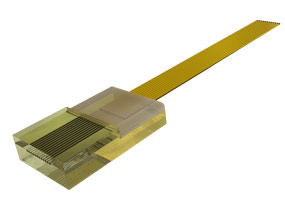
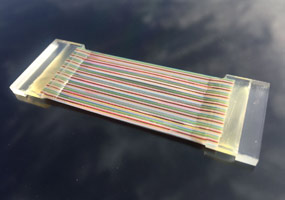
A lensed fiber array enables simultaneous coupling of multiple optical channels while maintaining high positional accuracy.
Compared with individual fibers, a lensed fiber array provides:
Multi-channel optical coupling
High-density optical interconnects
Excellent pitch consistency
Reduced assembly time
Improved packaging efficiency
Typical array pitches include:
127 μm
250 μm
Customized spacing
The lens geometry of every channel is manufactured with high precision, ensuring uniform optical performance across the entire array.
Modern photonic systems rely on lensed fiber technology across numerous industries.
Silicon photonic chips have extremely small waveguide dimensions.
Customized lensed fiber coupling minimizes mode mismatch and improves chip-to-fiber coupling efficiency.
High-speed optical modules require low insertion loss to maximize transmission quality.
Applications include:
Coherent communication
Data centers
Fiber optic transceivers
DWDM systems
Laser diodes often emit highly divergent beams.
A precision lensed optical fiber captures more optical power while maintaining stable alignment.
Medical imaging systems require tightly focused beams.
Customized lens geometry provides:
Higher image resolution
Better signal quality
Stable optical performance
Fiber optic sensing systems benefit from:
Improved signal collection
Increased sensitivity
Better repeatability
Applications include:
Industrial monitoring
Biomedical sensing
Environmental measurement
High-quality lensed fiber manufacturers utilize specialized grinding and polishing technologies rather than conventional cleaving methods.
The manufacturing process generally includes:
Fiber preparation
Precision grinding
Lens profile formation
Surface polishing
AR coating (optional)
Optical spot testing
Far-field measurement
Coupling efficiency verification
Advanced inspection equipment measures:
Spot size
Beam profile
Working distance
Lens radius
Surface quality
End-face geometry
Consistent manufacturing is essential for large-scale photonic packaging.
MEISU combines advanced optical manufacturing with extensive photonic packaging experience to deliver reliable lensed fiber solutions for demanding applications.
Key capabilities include:
Precision fiber lens grinding technology
High-accuracy lensed fiber array fabrication
Custom conical, angled, and spherical lensed fiber designs
Low-loss lensed fiber coupling optimization
Spot size and far-field testing
Optional anti-reflection coating
Prototype development to high-volume production
Support for silicon photonics, optical communications, medical devices, and sensing applications
With independently developed fiber lens processing equipment and rigorous quality control, MEISU helps customers achieve consistent optical performance while reducing packaging costs and accelerating product development.
A lensed fiber reshapes the emitted optical beam to better match the receiving optical mode, reducing insertion loss, minimizing beam divergence, and improving alignment tolerance.
A standard fiber has a flat end face and emits a naturally diverging beam. A lensed optical fiber features a precision-shaped tip that focuses or transforms the beam for more efficient optical coupling.
A lensed fiber array is commonly used in silicon photonics, photonic integrated circuits, optical transceivers, fiber array units (FAUs), PLC devices, LiDAR systems, and multi-channel optical testing.
A spherical lensed fiber provides excellent beam focusing, repeatable optical performance, and efficient coupling with laser diodes, VCSELs, and compact photonic devices.
Yes. Customization options include fiber type, lens geometry, working distance, spot size, anti-reflection coating, array pitch, and connector configuration to meet specific photonic packaging requirements.
Choose lensed fiber manufacturers with proven expertise in precision lens fabrication, comprehensive optical testing, customization capabilities, and scalable production for both prototypes and high-volume manufacturing.
 English
 日本語
日本語 한국어
한국어 français
 Deutsch
 Español
 italiano
 русский
 português
 العربية