A 2D collimator array is an important optical interface in high-port-count wavelength selective switching (WSS) systems. By arranging multiple fiber collimators in two dimensions, it enables higher port density, more compact optical layouts, and accurate beam positioning between optical fibers and free-space switching components.
For MEMS- or LCoS-based WSS systems, the performance of the collimator array directly affects insertion loss, channel uniformity, crosstalk, and overall switching accuracy.
Light emitted from an optical fiber naturally diverges. Before entering diffraction gratings, MEMS mirrors, LCoS devices, or imaging optics, the light must be converted into a controlled free-space beam.
A collimator array performs this function for multiple fiber channels simultaneously.
In a WSS system, it helps:
Maintain consistent beam positions across multiple ports
Provide accurate fiber-to-free-space optical coupling
Increase optical port density
Reduce the complexity of aligning individual collimators
Support compact WSS module designs
Compared with installing many independent fiber collimators, an integrated 2D array can provide better channel-to-channel consistency and simplify system assembly.
A traditional linear collimator array places all optical ports along one axis. As the number of WSS ports increases, this can require a larger optical aperture and wider beam-steering range.
A 2D configuration distributes ports across both X and Y directions.
This approach can help WSS designers achieve higher port density while making better use of the available optical area. It is especially useful in systems that use two-axis beam steering.
However, port density should not be maximized without considering optical performance. The final design must balance:
Collimator pitch
Beam diameter
Lens aperture
Switching angle
Optical aberration
Crosstalk
Insertion loss
The optimum collimator array is therefore determined by the complete WSS optical architecture.
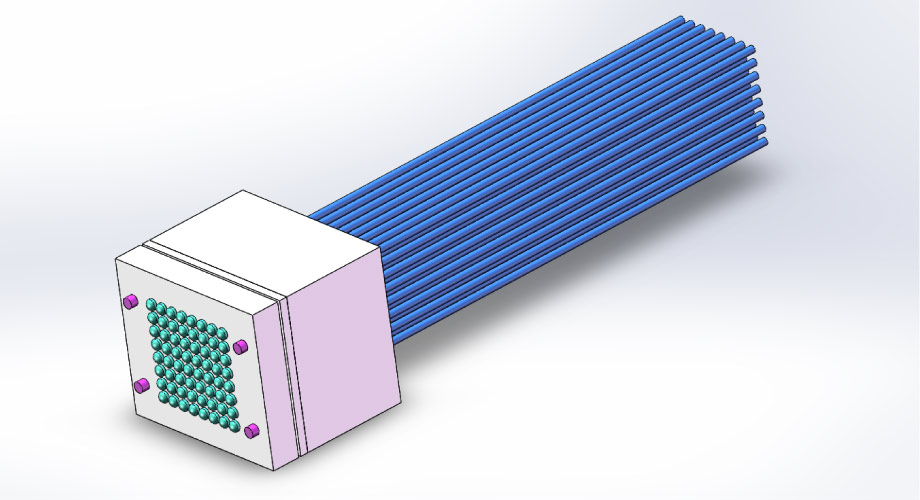
Pitch defines the center-to-center distance between adjacent collimators and directly influences port density and beam-steering requirements.
Smaller pitch can make the WSS more compact, but it also introduces tighter alignment tolerances.
Important factors include:
Accurate channel spacing helps ensure that each optical beam matches its intended switching position. Pitch errors may cause coupling loss, channel imbalance, or additional calibration requirements.
MEISU's 2D Optical Fiber Collimator Array supports customized pitch with pitch accuracy below 2 μm, making it suitable for precision optical switching applications.
The beam diameter must be compatible with the collimator pitch and the clear aperture of the optical system. Oversized beams may cause clipping or unwanted interaction between neighboring channels.
The distance between optical ports affects how far the beam must be steered. The required pitch should therefore be considered together with MEMS or LCoS steering capability.
Alignment is one of the key factors influencing WSS optical loss.
If the returned optical beam does not accurately match the receiving fiber mode, coupling efficiency decreases.
Several collimator parameters are particularly important:
Beam position: Lateral displacement can reduce coupling efficiency.
Beam angle: Angular errors may cause the beam to miss the optimum coupling position.
Working distance: The collimator working distance must match the free-space optical layout.
Spot size: Beam size affects diffraction, clipping, coupling efficiency, and switching-element utilization.
For this reason, working distance, spot size, pitch, and optical-axis accuracy should be considered together during WSS design.
When specifying a 2D collimator array, engineers should evaluate more than the number of optical channels.
Key parameters include:
| Parameter | Importance |
|---|---|
| Array configuration | Defines the WSS port layout |
| X/Y pitch | Determines port density |
| Pitch tolerance | Affects channel alignment |
| Fiber type | Determines optical and polarization behavior |
| Working distance | Must match the system optical path |
| Beam size | Influences coupling and diffraction |
| Operating wavelength | Affects fiber and lens selection |
| Mechanical dimensions | Determines module integration |
MEISU's 2D collimator arrays can be customized with different M × N configurations, pitch values, working distances, spot sizes, and SM, MM, or PM fibers.
Wavelength selective switches vary significantly in optical architecture.
Different systems may use different:
Port counts
MEMS or LCoS switching elements
Optical wavelengths
Beam sizes
Polarization requirements
Mechanical package dimensions
A standard collimator array may therefore not provide the optimum performance.
Customizing pitch, fiber type, beam characteristics, and mechanical dimensions allows the collimator array to match the WSS design instead of forcing the optical system to adapt to a standard component.
A 2D collimator array is a critical component in high-density wavelength selective switching systems. It provides a compact and repeatable interface between optical fibers and free-space switching optics while supporting accurate multi-channel beam positioning.
For reliable WSS performance, designers should carefully balance pitch accuracy, beam size, working distance, optical alignment, fiber type, and mechanical structure.
MEISU provides customizable 2D Optical Fiber Collimator Arrays for WSS, optical switching, OXC, and other high-density optical applications, with flexible array configurations and optical parameters to meet specific system requirements.
A collimator array converts light from multiple optical fibers into controlled free-space beams and couples switched beams back into the corresponding output fibers.
A 2D arrangement distributes optical ports across two dimensions, allowing higher port density and more efficient use of the available optical aperture.
Yes. Incorrect pitch or poor pitch accuracy can cause beam-position errors, resulting in reduced fiber coupling efficiency and higher insertion loss.
Depending on the application, 2D collimator arrays can use single-mode (SM), multimode (MM), or polarization-maintaining (PM) fibers.
Yes. Parameters such as array size, X/Y pitch, working distance, spot size, fiber type, and mechanical dimensions can be customized according to the optical system requirements.
 English
 日本語
日本語 한국어
한국어 français
 Deutsch
 Español
 italiano
 русский
 português
 العربية