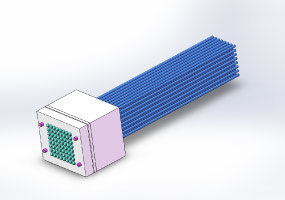
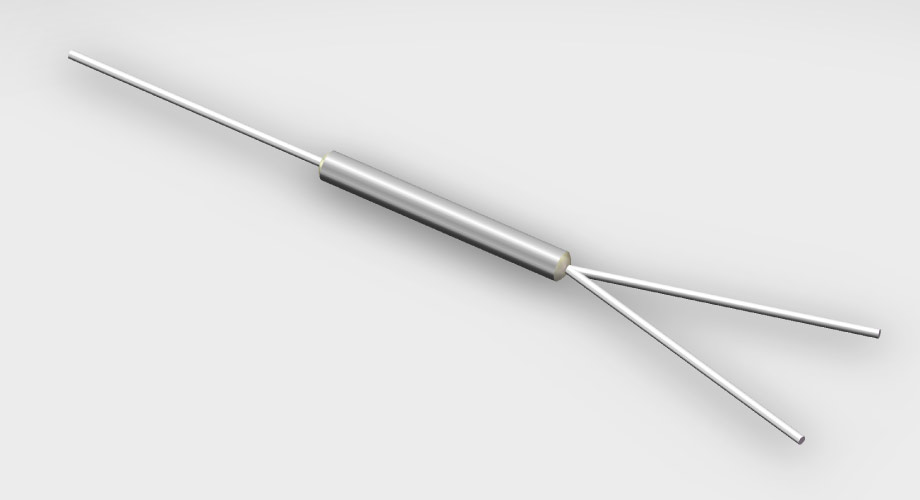
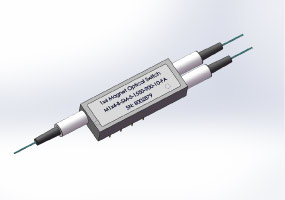
As optical systems become more compact and require more communication channels, manufacturers increasingly rely on multi-fiber components to simplify optical connections. Among these components, fiber array units and fiber array assemblies are widely used in photonic packaging, optical communication, sensing, testing, and other applications.
Although the terms may sometimes be used interchangeably, a fiber array unit and a complete fiber array assembly can represent different levels of integration. Understanding the distinction is important when designing an optical system or requesting a customized component from a manufacturer.
This guide explains the basic differences between these components, their typical structures, applications, and the specifications buyers should consider.
A fiber array unit is a component in which multiple optical fibers are precisely positioned and fixed into a defined arrangement.
The purpose is to maintain a controlled relationship between the fibers so that they can interface consistently with another optical component.
Depending on the design, a fiber array unit may include:
Multiple optical fibers
A glass or ceramic substrate
Fiber positioning structures
V-grooves or other alignment features
Adhesive or bonding materials
A connector or interface structure
Optional protective components
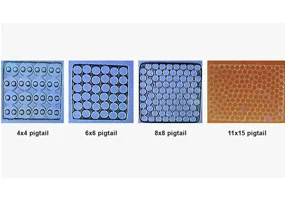
The fibers can be arranged in a straight line, two-dimensional pattern, or another customized geometry.
The exact construction depends on the application and the optical interface that the array needs to connect with.
An optical fiber array is a broader term referring to multiple optical fibers arranged and maintained in a predetermined geometric configuration.
Instead of handling individual fibers separately, an array creates a repeatable multi-channel optical interface.
This can provide advantages in applications where precise fiber spacing and stable positioning are required.
Common configurations include:
Fibers are arranged along one axis. This configuration is commonly used when optical channels are positioned in a single row.
Fibers are arranged in multiple rows and columns. This can support higher channel density and more complex optical interfaces.
The fiber ends are positioned at a defined angle to meet specific coupling or packaging requirements.
Lenses are incorporated at the fiber ends to shape or focus the optical beam for specific coupling applications.
The appropriate configuration depends on the optical device, channel arrangement, packaging space, and required coupling performance.

A fiber array assembly generally refers to a more complete optical component that incorporates the fiber array together with additional mechanical, optical, or protective structures.
For example, an assembly may include the fiber array plus:
Connectors
Ferrules
Mounting structures
Housing
Protective components
Optical lenses
Alignment features
Customized mechanical interfaces
The term therefore describes a broader integration level than simply the fiber arrangement itself.
The exact definition can vary between manufacturers, so buyers should always request a detailed component drawing and specification rather than relying solely on terminology.
The practical difference can be summarized as follows:
| Feature | Fiber Array Unit | Fiber Array Assembly |
|---|---|---|
| Multiple fibers | Yes | Yes |
| Defined fiber geometry | Yes | Yes |
| Basic positioning structure | Usually | Yes |
| Mechanical integration | Application-dependent | Usually more extensive |
| Connector | Optional | May be included |
| Housing/protection | Optional | More likely |
| Customized mounting | Possible | Common |
| Integration level | Component/sub-unit | More complete assembly |
The distinction is especially important during procurement.
A buyer looking for a basic fiber positioning component may only need a fiber array unit. A customer integrating the component directly into an optical module may require a complete assembly with mounting and protective structures.
Fiber arrays are used in many optical technologies because they simplify multi-channel connections.
Typical applications include:
Silicon photonics
Optical transceivers
Photonic integrated circuits
Optical switches
Fiber optic sensing
Optical testing
Wavelength division multiplexing
Data center interconnects
Laser coupling
Photonic packaging
In high-density optical systems, maintaining accurate fiber positioning becomes increasingly important because even small geometric deviations can affect optical coupling.
A precisely manufactured array can therefore provide a more repeatable interface than individually aligned fibers.
The required specifications depend on the application, but several parameters should normally be defined before placing an order.
Specify the total number of optical channels required.
Define the center-to-center spacing between adjacent fibers.
Specify whether the application requires single-mode, multimode, polarization-maintaining, or specialty fibers.
The end may be cleaved, polished, angled, or equipped with a lens depending on the coupling method.
Mechanical positioning accuracy should be specified according to the requirements of the mating optical component.
Glass, ceramic, or other substrate materials may be selected according to mechanical stability, thermal requirements, and assembly conditions.
Temperature range, humidity, vibration, and long-term reliability requirements should be considered for industrial or outdoor applications.
Standard products may be suitable when the optical interface follows common dimensions.
However, customization may be necessary when a project requires:
Non-standard fiber pitch
Unusual fiber count
Custom fiber arrangement
Specialized fiber types
Lensed fiber ends
Specific coupling angles
Special mechanical mounting
Tight alignment tolerances
Custom connector configurations
For prototype development, customization allows engineers to optimize the component around the actual optical interface. For mass production, the design can then be refined for repeatability and manufacturing efficiency.
Before ordering, buyers should provide as much technical information as possible.
Useful information includes:
Application
Fiber count
Fiber type
Fiber pitch
Operating wavelength
End-face configuration
Required alignment accuracy
Substrate material
Package dimensions
Environmental conditions
Expected production quantity
It is also useful to request technical drawings, inspection specifications, sample testing, and production tolerances.
This can reduce misunderstandings between the optical designer and component manufacturer.
A fiber array unit is primarily designed to position and maintain multiple optical fibers in a controlled geometric arrangement, while a fiber array assembly generally provides a higher level of mechanical and optical integration.
An optical fiber array can be configured as a linear, two-dimensional, angled, or lensed structure depending on the requirements of the application.
For engineers and procurement teams, the most important consideration is not simply whether a product is called a unit or an assembly. The key is to define the required fiber count, pitch, fiber type, end-face design, alignment tolerance, mechanical interface, and environmental requirements.
By matching the array configuration to the actual optical system, manufacturers can achieve more reliable multi-channel connections and simplify the transition from prototype development to production.
A fiber array unit is a component that holds multiple optical fibers in a precisely defined geometric arrangement for multi-channel optical coupling or connection.
An optical fiber array is used to provide a controlled multi-fiber interface in applications such as optical communication, silicon photonics, photonic packaging, sensing, and optical testing.
A fiber array unit generally focuses on precise fiber positioning, while a fiber array assembly may include additional connectors, housing, mounting structures, lenses, or other mechanical and optical components.
Yes. Fiber count, pitch, fiber type, arrangement, substrate, end-face configuration, and mechanical dimensions can be customized for specific applications.
A linear array positions fibers along one axis, while a 2D array positions fibers across multiple rows and columns. The appropriate configuration depends on the optical interface and available packaging space.
Provide the fiber count, pitch, fiber type, operating wavelength, end-face configuration, alignment tolerance, substrate requirements, dimensions, environmental conditions, and expected quantity.
Yes. Fiber array units can provide a controlled multi-channel interface for photonic chips and can be customized according to the chip's optical channel layout and coupling requirements.
 English
 日本語
 한국어
 français
 Deutsch
 Español
 italiano
 русский
 português
 العربية